

Adult Age, Adult Wage: What This Fair Work Decision Means for Employers
A Significant Shift in Workplace Law
A major change is underway in Australia’s employment landscape, and it will directly affect businesses that rely on younger workers.
The Fair Work Commission has ruled that junior pay rates for employees aged 18 to 20 in the retail, fast food and pharmacy sectors will be phased out over the coming years. In practical terms, this means that workers who are legally adults will increasingly be entitled to full adult pay, regardless of age. below is an overview of the intended phasing currently in discussion:
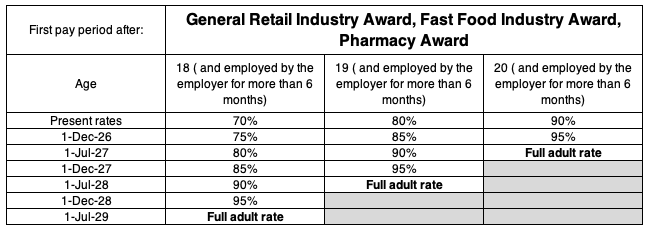
Breakdown of Junior rates of pay phased increases
For employers, this is more than a technical adjustment. It represents a structural shift in how labour is priced—and how teams need to be managed.
Why Junior Pay Rates Are Being Removed
Junior pay rates have historically been justified on the basis of age, experience, and productivity. Younger workers were paid a percentage of the adult wage, reflecting the assumption that they required more training and oversight.
The Fair Work Commission’s position is that this model no longer reflects the realities of the modern workforce.
If an individual is legally an adult and performing the same role under the same conditions, the argument is that they should be paid the same. This decision also sits within a broader economic context, where cost-of-living pressures are impacting younger workers just as significantly as older employees.
At its core, the ruling is about fairness and consistency. However, its impact on business operations is more complex.
The Real Impact on Employers
For many businesses—particularly in retail and hospitality—labour is one of the largest operating costs.
The phased removal of junior rates will gradually increase wage expenses for 18 to 20-year-old employees. While the transition period provides some breathing room, the direction is clear: labour costs are rising.
In response, some employers may:
Tighten hiring criteria
Prioritise more experienced workers
Reduce hours or restructure rosters
Look for productivity gains elsewhere
There is also a risk that entry-level opportunities for younger workers could become more limited if employers shift toward candidates who can immediately justify the higher wage.
Why This Is More Than a Cost Issue
It would be easy to view this change purely through a financial lens. That would be a mistake.
What this decision really does is remove the buffer that lower-paid labour often provides. Inefficiencies that may have previously gone unnoticed will become more visible—and more expensive.
When wage differences narrow, the focus shifts to performance.
Businesses will need to be clearer on:
What “good” actually looks like in each role
How performance is measured
How quickly new employees are brought up to standard
Without this clarity, the cost increase will be felt more sharply.
The Shift Toward Performance and Structure
Equal pay brings an implicit expectation of equal contribution.
This means performance management can no longer be informal or inconsistent. Businesses will need:
Clear expectations from day one
Structured onboarding processes
Regular feedback and accountability
Hiring decisions will also become more deliberate. If pay is no longer a differentiator, capability, attitude, and reliability carry more weight.
This doesn’t mean younger workers should be overlooked. It does mean they need to be set up properly to succeed—and to contribute at the level the business requires.
Rostering and Operational Discipline
Rostering will come under increased pressure as labour costs rise.
Inefficient scheduling, overstaffing during quiet periods, or underutilising team members will have a more direct impact on profitability. This is an opportunity for business owners to reassess how labour is deployed and ensure it aligns closely with demand.
In practical terms, this may involve:
Reviewing peak and off-peak staffing levels
Aligning shifts more tightly with sales patterns
Removing unnecessary or low-value hours
Operational discipline will become a key lever in managing the impact of this change.
Culture as a Competitive Advantage
As pay becomes more consistent across age groups, other factors will play a larger role in attracting and retaining staff.
Employees will increasingly choose workplaces based on:
The quality of leadership
Team culture
Flexibility and work environment
Opportunities for development
Businesses that invest in these areas will be better positioned to retain strong team members, even as wage structures change.
A Window to Prepare
Importantly, this change will not happen overnight. The Fair Work Commission has indicated that the transition will be phased in over several years.
This provides a window for businesses to prepare—but it is not a reason to delay action.
The most effective approach is to:
Review your current workforce structure
Assess team performance and capability
Strengthen onboarding and training systems
Implement clearer performance expectations
Waiting until costs increase before making adjustments will limit your options.
Final Perspective
This decision reflects a broader shift in how work is valued, particularly for younger employees.
Whether you agree with it or not, it is now part of the operating environment. The question is not whether it will impact your business, but how well you respond to it.
Businesses that take a proactive approach—tightening systems, improving leadership, and increasing operational discipline—will be in a stronger position not just to absorb the change, but to benefit from it
Need Help Getting Ahead of This?
If you’re unsure how this change will impact your business—or you want to use it as an opportunity to strengthen your team—I help business owners put the right HR structures in place so their teams perform and their costs stay under control.
You can start with my free guide:
“5 HR Basics Every Business Owner Should Nail”
or book a call to talk through your specific situation.
